No items in cart
Buy 2 Get 1 Free
Add 3 products to the cart and get the cheapest for free at checkout.
Add 3 products to the cart and get the cheapest for free at checkout.

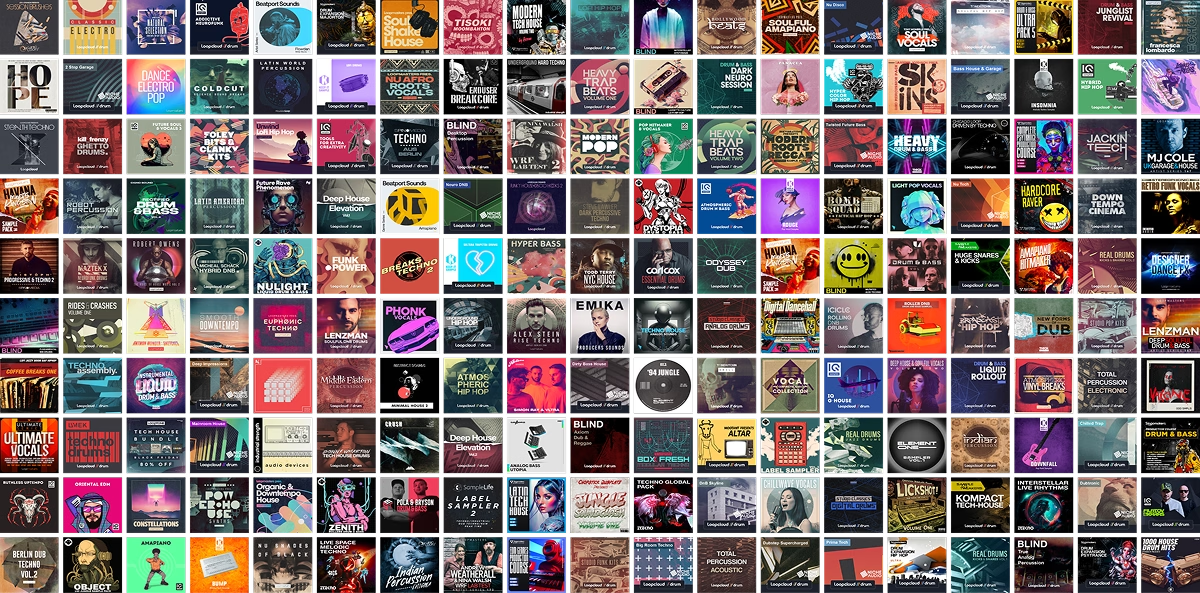
If you build your tracks with samples as your raw material, you know that finding great content and choosing material that works is essential.
After all, when you’re working with elements that will be looped, repeated or heard continuously as one-shots, the stakes are pretty high.
But how can you choose great samples for the foundations of your track? Where should you look for your material and what should you consider during your search?
In this article I’ll lay out the basics of sample selection, propose three ways to refine your sample choosing skills and suggest a great source for royalty-free samples.
Let’s get started.
At the dawn of the sampling revolution, artists simply used whatever they could get their hands on, usually in the form of vinyl records.
Early sampling devices like the AKAI MPC 60 gave birth to the classic workflow of digging through record store crates for sampling gold.
While this method is still widely practiced, there’s a major problem for most producers—rights management.
Commercially produced music that was released as a vinyl LP is almost always the property of a rights holder, no matter how vintage and forgotten it might seem.
When it comes to this type of release, you’ll often be dealing with a label, an artist and potentially even a publisher that each need to be informed and compensated to clear this type of material for sampling.
Major label artists may have the budgets and professional support to make it work, but independent producers working without those kinds of resources need to find other solutions.
Enter the world of royalty-free sample libraries. As the sampling revolution continued, more and more artists started finding their inspiration by sampling existing audio,
With commercially produced music off the table for general use, libraries of freely usable audio material began to appear.
As communities developed around platforms like Loopcloud, artists could search for nearly any type of sample imaginable, from one-shot percussion to full track stems.
Created from the start with sampling in mind, royalty-free libraries charge a small fee to download the material hosted on their site. But unlike other sources, a special license provided by the platform gives you free reign to use the material any way you see fit, from the smallest segment to nearly complete tracks.
As more artists and producers joined the platform, the number of libraries began to explode, with hundreds of thousands of sounds, packs and collections now available on Loopcloud.
With so many samples available on royalty-free platforms, how do you go about choosing sounds that will work for your track?
Here are my top sample selection tips and three ways to improve your digital crate-digging experience on royalty-free sample libraries.
It may seem like there are an infinite number of genres in the modern musical landscape.
But even small distinctions between subgenres can take you in a completely different direction when you’re searching for specific sounds or samples.
Take the time to learn the difference between related genres like tech house and progressive house, or dub techno and minimal techno. Electronic genres are often defined by specific tempos, beat patterns and stylistic elements, so having a general sense of the different subgenres will help you find what you’re looking for faster.
Make sure you’re familiar with any specific terms related to the genres you’re working in and learn any genre conventions that you might need to identify when browsing sounds.
Finally, keywords are king when it comes to searching through big sample libraries. Pay attention to filenames, tags and other metadata as you navigate through large collections to get a sense of how sounds are organized within.
A sample label is an outfit that creates samples specifically for use in royalty-free libraries. Sample labels are usually made up of a few core producers who create sounds for many different applications.
If you find a specific label that matches your aesthetic and produces content you like, make sure to check back regularly for new releases that might work for your tracks.
Loopcloud has dozens of respected sample labels creating content across the platform, so take the time to explore the different imprints and get a sense of what they’re all about.
Cycling through hundreds of nearly identical kicks or snares looking for just the right one can get tedious pretty quickly.
Without context, you’re taking blind guesses that can be impacted by factors like loudness, novelty and quality in isolation.
But at the end of the day, one-shots like kicks and snares may be repeated hundreds of times throughout a track. By the end of the run time, your audience will have spent considerable time with these elements, so getting them right is important.
Counterintuitively, just browsing faster through more and more options isn’t going to help you uncover a hidden gem. Instead, listening in context and evaluating based on the entire fit with the track is the best possible option.
Not every sound needs to be perfect, so be aware of how you can change or alter the character of a sample with EQ, compression or saturation. Getting it right is part experience and part intuition, but you’ll eventually develop a sense for when to stop scrolling and
In the end, the perfect sample is the one that fits with your song. Whether you’re looking for a topline hook, a bassline loop or a simple one-shot kick, royalty-free sample libraries like Loopcloud have an enormous depth of content to explore.
The best part about working with existing audio is that inspiration can come from anywhere. Browsing through packs and labels or searching through obscure titles and tags can feel like an archeological dig to uncover hidden gold.
Now that you understand the basics, get back to your royalty-free sample library of choice and keep digging.
We're excited to partner with Loopcloud to bring you this offer! Loopcloud gives you unlimited access to over 5 million royalty free samples, loops, and one shots, plus smart search tools that help you find the sound you're hearing in your head. Claim your 90 day free trial and start building today.


.png)
.avif)