No items in cart
Buy 2 Get 1 Free
Add 3 products to the cart and get the cheapest for free at checkout.
Add 3 products to the cart and get the cheapest for free at checkout.

LFOs are one of the most important components of a modern synthesizer.
They introduce change over time to the sounds you create with your synth’s oscillators, filters and amplifiers. In fact, LFOs are so central to synthesis that they likely play a role in every synth sound you hear in a song.
But LFOs can be confusing if you’re just getting started with synthesis. After all, modulation is a deep topic with many applications in sound design.
Still, there’s nothing challenging about LFOs once you understand the basics. In this article, I’ll break down what LFOs are, explain the role they play in synthesis and suggest three core techniques to help you use them in your own synth patches.
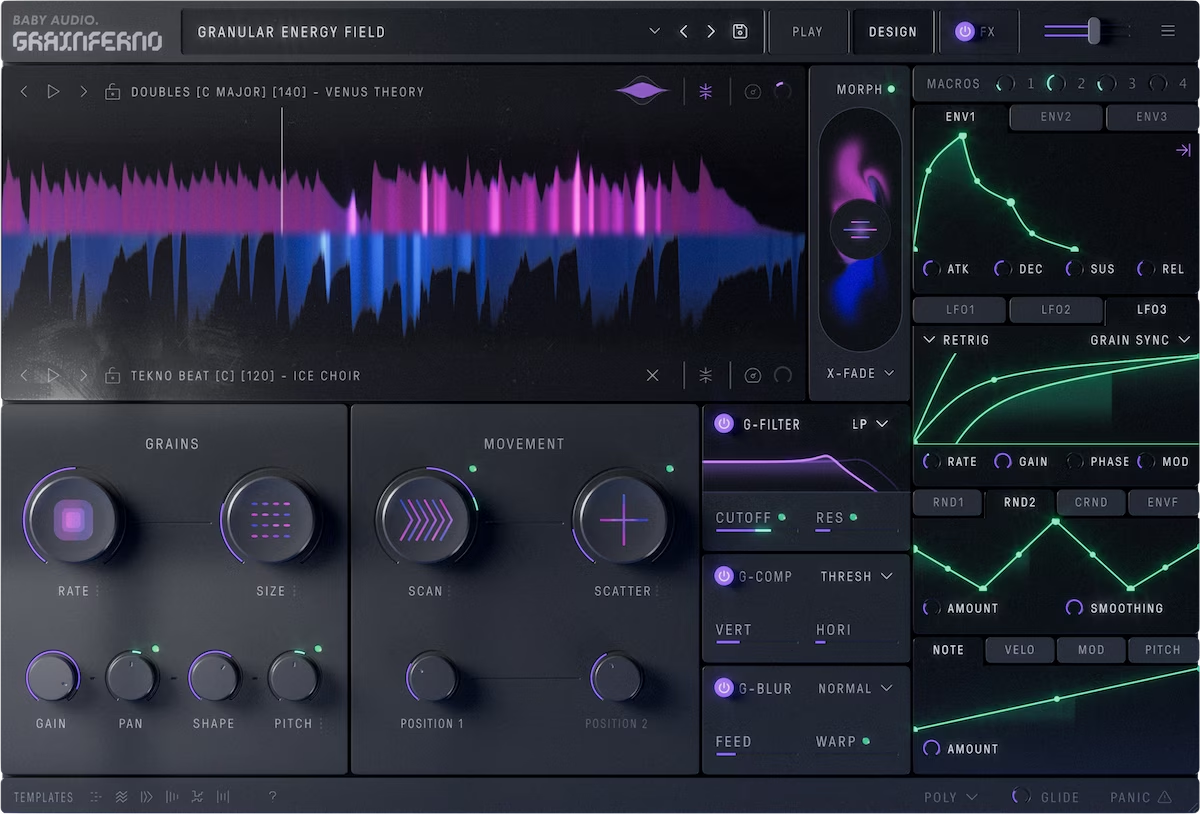
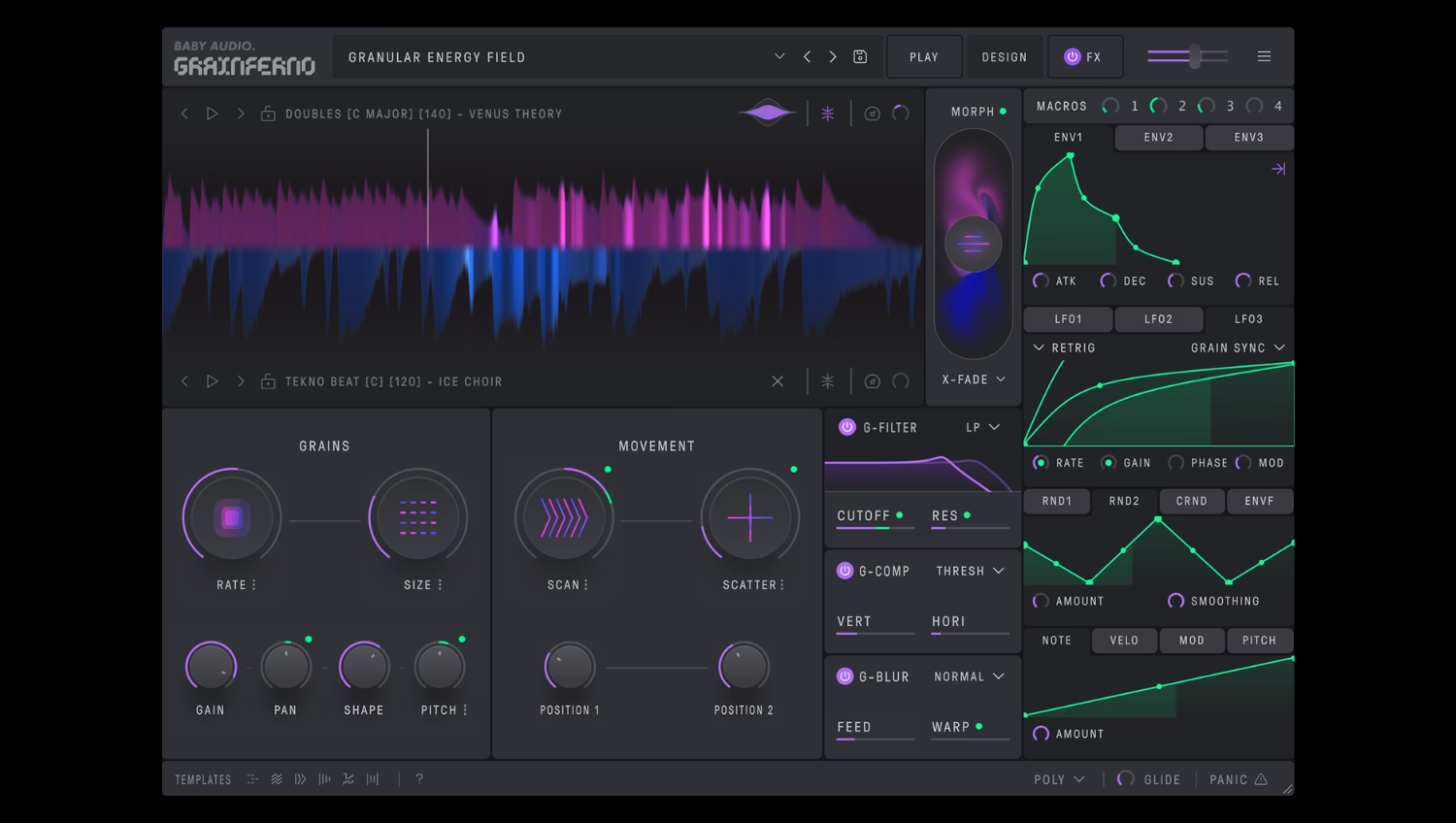
LFO stands for low frequency oscillator. It’s a standard element in analog-style subtractive synthesis, but it appears in many other styles such as granular synthesis.
They’re called low frequency oscillators because they create waves with much longer wavelengths than those of your synth’s main oscillators.
LFOs add animation to static sounds by modulating one or more of the synth’s parameters.
Synths often include multiple LFOs for adding different dimensions of modulation and generating sounds with richer and more varied textures.
Modulation in synthesis means predictable change over time that alters a sound’s timbre to make it more pleasing, musical or familiar in its musical role.
The simplest type of modulation is the slow, regular type of pitch modulation called vibrato. Vibrato is the musical term for sustained tones that waver gently up and down in pitch as they ring out.
It’s a common technique for many instrument types such as strings, wind instruments and even vocals.
When you break it down, vibrato is just an ongoing change to the sound’s fundamental frequency that cycles back and forth from high to low.
When you connect an LFO to a synth oscillator’s frequency, a similar effect takes place.
The frequency range of an LFO is much lower than that of an oscillator that produces a discernable musical tone. Instead the LFO varies the oscillator frequency up and down according to its own rate. As you increase and decrease the LFO frequency, the vibrato becomes fast or slower.
As you increase the amplitude of the LFO wave, the vibrato deepens, increasing in intensity as the distance from low to high becomes more pronounced.
This type of modulation is easy to hear, but LFOs can be applied to nearly every element of a subtractive synthesizer. You’re probably familiar with the sound of LFOs modulating the cutoff frequency of a low-pass filter or the level of a synth amplifier. But there’s much more to explore once you get started—more on that later!
At their core, LFO are just oscillators. Most come equipped with similar waveshapes to those found in main synth oscillators.
However, familiar waveshapes behave differently when used as modulation sources with LFOs.
Here is a list of the most common LFO waveshapes and a quick explanation of their results when used to modulate other parameters on your synth.
Sine is the simplest wave type and while it might not often be found on your synth’s audio oscillators it can be very effective on an LFO.
Sine waves produce gentle modulation that rises and falls smoothly throughout the wave’s entire cycle. They’re particularly useful for gentle vibrato as in the example above, or subtle detuning in a two oscillator synth.
Triangle waves are the default option for many onboard LFOs and can be used for various different modulation types.
Triangle waves progress linearly throughout their range from top to bottom and then back again. That makes them perfect for long, drawn-out modulation patterns that maintain the same rate of change over time.
Use triangle waves for long filter sweeps that unfold over multiple bars, progressing through their cycle at a uniform rate.
Square waves alternate abruptly between low and high values. They produce a distinct type of modulation that’s easy to identify thanks to its predictable change between steady values.
Square wave LFOs are often used to modulate a synth’s amplifier section, producing the choppy stuttering effect known as tremolo.
However, there’s plenty more you can do with square waves. For example, If your synth offers panning between left and right, square wave modulation can produce rapid oscillation between channels or an enveloping, psychedelic effect.
Sawtooth or Ramp waves rise from low to high before reaching their maximum and starting from the bottom again.
Ramp waves combine the uniform rising action of triangle waves with the abrupt change of square waves in an interesting combination.
While this wave shape is less commonly found on traditional LFOs, it has some unique uses. Try using ramp waves modulate effect parameters such as drive for a repeating increase in intensity with rhythmic qualities.
Some LFO systems allow you to freely draw the shape of an LFO wave using breakpoints with adjustable slope.
This style of input allows you to create extremely flexible patterns and control their behavior with precision.
Drawable LFOs are similar to looping envelopes and the distinction between the two starts to break down when you can add multiple sloping breakpoints.
But since the drawn pattern repeats regularly according to the set rate, you can think of them like LFOs with a very complex waveshape.
If you’re looking for modulation shapes that can’t be created using other methods, synths with drawable LFOs let your ideas run wild.
Random LFOs generate random parameter values according to a set rate. This allows you to introduce modulation without the predictable qualities of a cyclical wave.
Though they might sound chaotic, random LFOs and their cousins sample and hold generators can be used to add all kinds of helpful animation to your sounds.
Try random modulation anywhere your patch feels static and unengaging. Slow rates and lower amount values can help you reign in the chaos, and some synths even feature a smoothing control to soften the transition between successive random values.
The great thing about LFOs is the creativity they can inspire once you understand the basics.
There’s no one way to create modulation with LFOs in your patches and the only limit is your imagination.
The best way to find new LFO routings is to experiment with your synth and try unique combinations.
But if you’re just looking for a place to start, here are a few ideas to help you get inspired.
If your synth has the capability to sync one oscillator to another, routing an LFO to the sync’d oscillator creates a unique effect.
Since the period of the synced oscillator will reset at the beginning of each new cycle of the main oscillator, the apparent pitch of both combined will always be related.
This means you can modulate the pitch of the synced oscillator for a unique fluctuating upper harmonic.
Try using a triangle wave, sine wave or random LFO source to modulate oscillator pitch when sync is active.
Square waves are sometimes called pulse waves when a synth offers the ability to vary the width of the wave's pulse signal.
The pulse width, or duty cycle, is the duration that the pulse wave spends at its maximum position within the periodic cycle.
Varying the pulse width can take a basic square wave from a fat humming tone to a pinched, hollow one while still retaining the characteristic buzzing of a square wave.
Modulating the pulse width with an LFO creates an evolving shift in timbre across the oscillator’s duty cycle.
Filter resonance often gets passed over in favor of the cutoff frequency for modulation.
But modulating resonance can help expose different characteristics of a filter, especially if the cutoff already has some animating modulation.
When it comes to resonance, quick shifts can often be more engaging than progressive sweeps.
Try using a random LFO to modulate filter resonance and experiment with different cutoff frequencies to bring out the action.
It’s even more fun if you can sync the random LFO’s rate to a tempo division and generate new random values on every note in a sequence.
LFOs are a cornerstone of synthesis that every producer and sound designer should master.
Once you get started, you’ll find that understanding them will help you create sounds faster and more effectively.
Whether you’re working with vintage-style synths or cutting edge granular techniques, LFOs are the key to compelling change over time in your sounds.
Now that you understand the basics of LFOs, get back to your DAW and set some sounds in motion.


.png)

.avif)