No items in cart
Buy 2 Get 1 Free
Add 3 products to the cart and get the cheapest for free at checkout.
Add 3 products to the cart and get the cheapest for free at checkout.

.avif)
Innovative sound design has always been a foundational element of modern film scores.
Composers use specially crafted sonic textures to support their compositions and pull movie-goers deeper into the world of the film.
Alongside cutting edge visual effects, modern synthesis techniques help create the immersive cinematic experiences of the biggest blockbuster films, from sci-fi epics to prestige dramas and bonechilling horror.
So what exactly is sound design for film? Where do synthesizers fit in, and how is the practice evolving?
In this article I’ll break down the basics of sound design for film, trace the history of synthesizers in cinema and walk through four cinematic atmospheres you can create with the right synth tools.
Let’s get started.
Film sound design is the process of creating audio material for use in movies. The term covers everything from score recording and production to dialog editing, foley, and sound effects.
Within that broader practice, sound design plays a particularly important role in the music composed to underscore a film's dramatic action. While today's cinematic scores can include anything from traditional orchestral arrangements to licensed pop songs, more and more tentpole films rely on synthesized sound to set their tone.
With composers like Hans Zimmer, Ludwig Göransson, Trent Reznor, and Atticus Ross leading the charge, innovative synthesis has stepped into a starring role in modern cinema.
Electronic instruments have shaped cinema sound design since the earliest days of commercially available synthesizers
When the first synths from Moog, ARP, and Buchla arrived in the 1960s, their futuristic timbres captured the public imagination at the height of the space race, quickly becoming shorthand for the emerging genre of science fiction.
From Wendy Carlos's synthesized realizations of Beethoven and Rossini in Stanley Kubrick's A Clockwork Orange to the iconic swoosh of a Star Wars lightsaber, composers used synthesis to bring futuristic worlds to life on screen.
While synths frequently appeared in genre films during the 1970s, the 80s saw artists like John Carpenter and Vangelis expand their range with atmospheric soundtracks like Escape from New York and Chariots of Fire.
These films pioneered the practical use of soundtracks composed entirely using synthesizers, which continues today with scores like Disasterpeace’s celebrated chiptune work on modern horror classic It Follows.
The digital revolution of the late 1990s changed the game again. Film composers began working with software synthesizers inside their DAWs, blending traditional composition with digital sound design to unlock a new generation of cinematic textures. Combined with advances in CGI, the lush and detailed worlds of modern blockbusters simply could not exist without cutting-edge synthesis.
While synthesized elements turn up in essentially every modern film project, synths still play to their strengths in certain genres and settings.
Here are four common cinematic atmospheres with prominent synthesized elements and the sound design approaches behind them.
The 80s were the golden era of slasher horror, gritty crime thrillers and retrofuturistic sci-fi—and the decade’s signature sound was the analog synthesizer.
Films like Michael Mann’s Thief and Ridley Scott’s iconic Blade Runner established synth scoring styles that composers still draw on today.
With the recent wave of 80s film nostalgia, plenty of film composers reach for classic synth textures to evoke the decade’s distinctive atmosphere.
Sound design for 80s-inspired scores relies heavily on authentic analog synthesis: warm sawtooth leads, gated reverb on drums, pulsing arpeggios, and lush polysynth pads that recall specific hardware instruments of the era.
To nail an authentic 80s-style synth sound, BA-1 is hard to beat. Inspired by a beloved 80s hardware synth and updated for modern producers,, BA-1 is supported by a deep library of genre-focused presets.
Check out packs like Sunglasses Kid’s Cinematic 80s, Michael Oakley’s Cyberpunk, and Prof. Sakamoto’s Chiptune Legacy to load BA-1 with instant period character.
Modern audiences can’t get enough post-apocalyptic fiction. From the video-game inspired The Last of Us to 2025’s 28 Years Later, cinematic visions of a future after civilizational collapse captivate viewers with the help of immersive sound design.
But some of the most haunting apocalyptic settings rendered on film have been inspired by real-life events. Hildur Guðnadóttir’s groundbreaking score for HBO’s 2019 series Chernobyl captured the creeping horror of the Soviet nuclear disaster with extraordinary restraint.
Working from field recordings made inside a decommissioned Lithuanian nuclear plant, Guðnadóttir's spare, barely-tonal drones hover over refracted industrial soundscapes with the invisible dread of radioactive contamination.
This kind of hybrid sound design is exactly what granular synthesis tools are built for. Grainferno deconstructs existing audio and rearranges it into everything from guttural drones to shimmering grain clouds, making it well suited to the kind of unsettling, first-person atmospheres that define this style of score.
Try loading a field recording into one of Grainferno’s sample slots and generating a drone from the other using a monophonic one-shot. Turn up the scatter control to add skittering unpredictability to the patch and use the morph control to blend between the two.
Arguably the score that kicked off the modern era of synthesis in cinematic music was Trent Reznor and Atticus Ross’s Oscar-winning work on David Fincher’s The Social Network.
The Nine Inch Nails duo were a seemingly unlikely fit for a biographical drama about the founding of Facebook, but that’s exactly what made the score work.
Reznor has spoken at length about the unconventional instruments used in the production. To create the intense detuned clusters marking the film's most dramatic moments, the duo turned to a handmade boutique synth called the Swarmatron built by Brooklyn-based instrument makers Brian and Leon Dewan.
And who could forget their iconic version of In the Hall of the Mountain King, a synthesized rendering of Grieg that consciously recalls Wendy Carlos's pioneering work on A Clockwork Orange nearly half a century later.
Top composers turn to new paradigms in synthesis when they need to evoke alien environments in the unknown far future. Hans Zimmer’s sprawling scores for the first and second Dune films showcase this approach at its most ambitious.
Frank Herbert's beloved space opera called for a singular blend of ancient and futuristic elements, and Zimmer went to extraordinary lengths to find it. His team built custom instruments, processed vocal performances beyond recognition, and combined advanced synthesis with physical instruments and deep layers of effects to bring Arrakis to life.
That hybrid quality is exactly the territory where physical modeling synthesis comes into its own. Unlike subtractive or FM synthesis, physical modeling simulates the actual properties of vibrating objects. The results can sound startlingly real, or veer into textures that no acoustic instrument could ever produce.
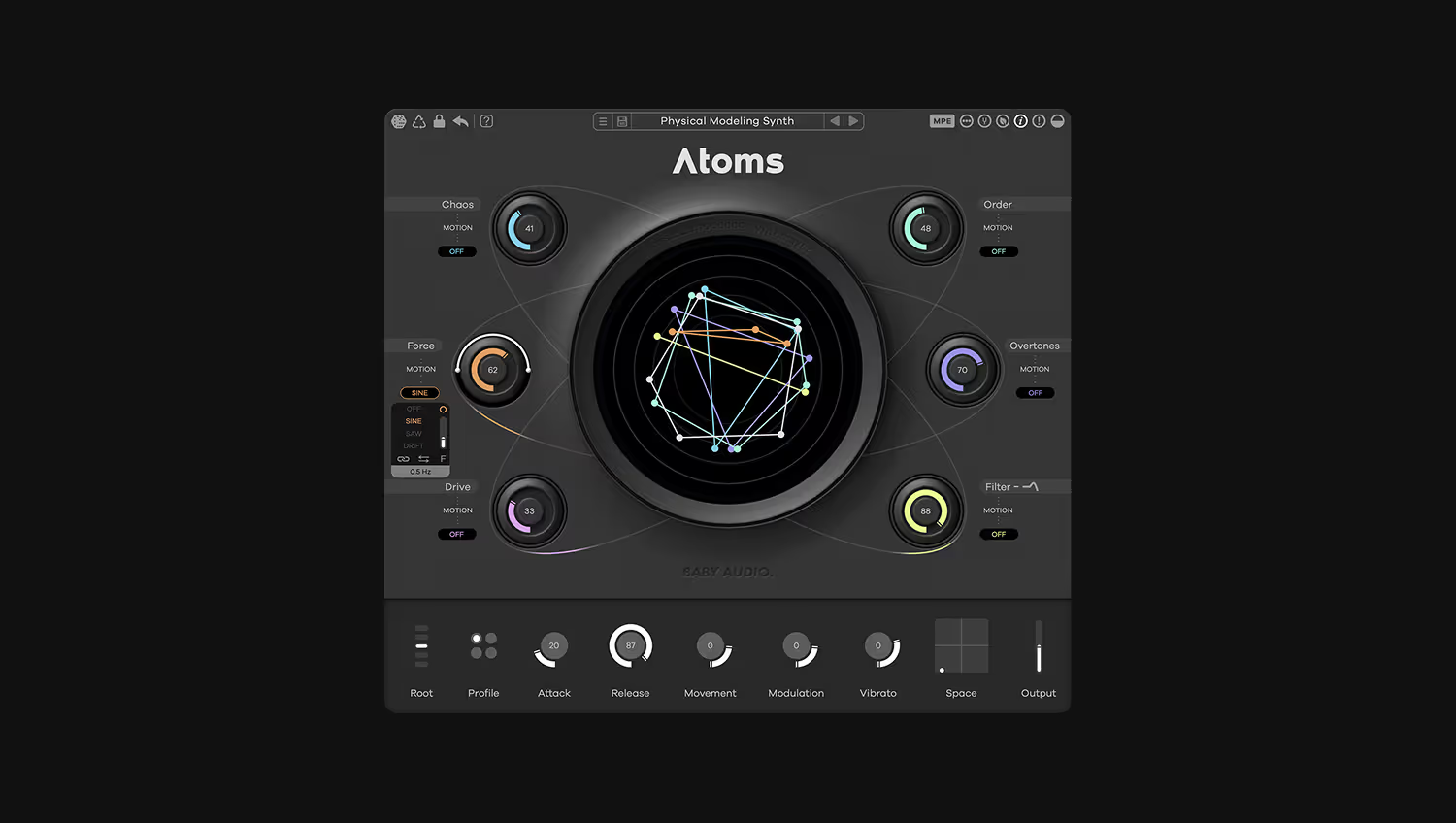
Atoms' mass-spring interaction model is built for exactly this kind of work. Try the lo-fi profile with plenty of motion applied to the Force, Chaos, and Order controls for a gritty, evolving texture with unpredictable overtones that border on atonal.
Film sound design continues to evolve as new creative possibilities emerge alongside technological advancement. But across half a century of innovation—from Wendy Carlos's Moog experiments to Hans Zimmer's Dune—synthesizers have cemented their place as a core part of the language of cinema.
Whether you're chasing the warm analog glow of the 80s, the unsettling drones of modern apocalyptic horror, the cold electronic tension of prestige drama, or the otherworldly textures of far-future sci-fi, the right synthesis tools make all the difference.
Now that you have a sense of the landscape, explore the Baby Audio synths mentioned throughout this article and start building your own cinematic soundscapes.


.png)
.avif)